
Uganda's 132kV network is the backbone that moves power from the country's generation stations to the substations that, in turn, feed the 33kV and 11kV distribution lines most businesses actually connect to. For engineering firms, contractors, and independent power producers, it is also where a large share of the near-term commercial opportunity in the sector sits: new substations, line extensions, protection and control upgrades, and the interconnection studies that any embedded generation project above a certain size must eventually pass through. This article sets out how the transmission layer is structured, who the key institutional players are, and where private sector firms can realistically add value today.
1. Where 132kV Sits in the Network
Uganda's transmission system is built primarily around 132kV lines, with a smaller and growing 220kV backbone linking major generation sites to load centres over longer distances. The 132kV layer is the workhorse tier: it carries power from generation and the 220kV network down into regional substations, from which 33kV primary distribution feeders fan out to towns, industrial zones, and rural growth corridors. Almost every large industrial or institutional client considering a significant grid-connected project, whether that is a new factory, a large embedded generation asset, or a mini-grid tied into the national system, will eventually need to understand how their point of connection relates to the nearest 132kV substation and its available capacity.
2. The Institutional Landscape
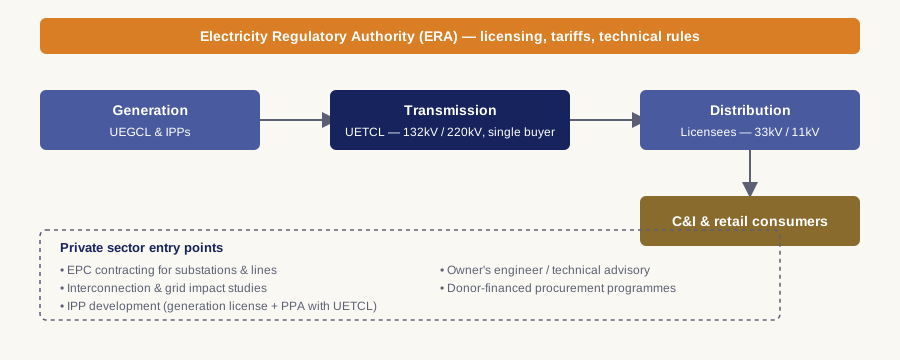
Uganda's electricity sector is unbundled across generation, transmission, and distribution, each with distinct institutional responsibility:
- Uganda Electricity Transmission Company Limited (UETCL) owns and operates the national transmission grid, including the 132kV and 220kV networks, and acts as the single buyer of bulk electricity from generators for onward sale to distributors and large direct customers.
- Uganda Electricity Generation Company Limited (UEGCL) owns major public hydropower generation assets, alongside a number of independent power producers operating hydro, thermal, and solar plants under generation licenses.
- Distribution licensees, principally Umeme Limited historically and its successor arrangements under the national distribution concession, take power from the transmission network at 33kV and below and deliver it to end consumers.
- The Electricity Regulatory Authority (ERA) licenses generation, transmission, and distribution activities, approves tariffs, and sets the technical and commercial rules that govern how private parties interconnect with the grid at any voltage level.
For a private engineering or development firm, this structure matters practically: a substation upgrade or line extension proposal will typically require engagement with UETCL for transmission-level matters, the relevant distribution licensee for lower-voltage interconnection, and ERA for licensing and technical compliance, often in parallel rather than in a single sequential process.
3. Where Capacity Constraints Actually Bite
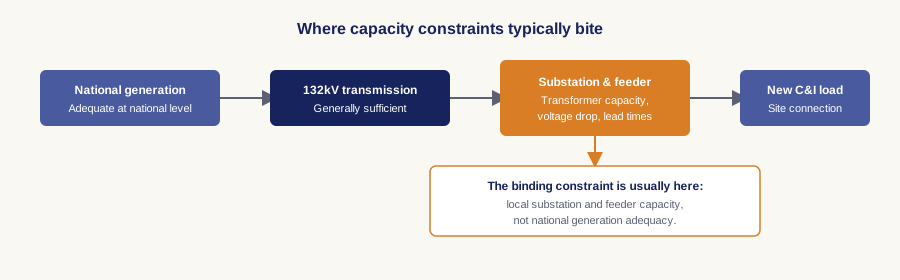
Uganda has added substantial generation capacity over the past decade, to the point where national generation capacity now comfortably exceeds peak demand in aggregate terms. The binding constraint for most new C&I connections is therefore rarely generation adequacy at a national level. It is far more often local: transformer capacity at a specific substation, the thermal or voltage-drop limit of a specific 33kV or 11kV feeder, or the lead time required to build or upgrade the line segment that would serve a new load. This distinction matters for how private firms should scope early-stage feasibility work: the relevant question for a prospective client is rarely "does Uganda have enough power," but rather "does the specific substation and feeder serving this site have enough spare capacity, and if not, what does reinforcement cost and how long does it take."
4. Regulatory Entry Points for Private Firms
Private sector participation in the 132kV-and-above segment of the network takes several practical forms, each with a different regulatory pathway:
- Engineering, procurement, and construction (EPC) contracting for new substations, line extensions, and protection upgrades, typically procured directly by UETCL, distribution licensees, or donor-funded programmes, and governed by standard public procurement rather than generation licensing.
- Interconnection and grid impact studies commissioned by developers of generation or large embedded loads, required before ERA and the relevant network owner will approve a connection above defined capacity thresholds.
- Independent power producer (IPP) development, which requires a generation license from ERA and a power purchase agreement, typically with UETCL as the off-taker, and involves its own transmission interconnection study as a condition of the license.
- Owner's engineer and technical advisory roles supporting developers, lenders, or public agencies through the design, procurement, and commissioning stages of transmission and substation projects, a role increasingly sought by international financiers as a condition of funding.
5. Donor and Development Finance Influence
A significant share of transmission and substation investment in Uganda continues to be financed or co-financed by development finance institutions and bilateral donors, which shapes both the pipeline of available work and the technical standards firms are expected to meet. Procurement under donor-financed programmes typically follows the funder's own procurement guidelines rather than purely domestic rules, and often carries more demanding documentation, environmental and social safeguard, and quality assurance requirements than comparable domestically funded work. Firms seeking to participate in this segment benefit from building institutional familiarity with these procurement frameworks well before a specific tender is published, since pre-qualification and track record requirements are frequently a binding constraint on who can bid at all.
6. Implications for Engineering Firms
Three practical conclusions follow from the structure described above. First, credible participation in transmission-level work requires relationships and technical credibility with UETCL and the relevant distribution licensee independently, since neither can be treated as a proxy for the other. Second, the most reliable near-term opportunity for most firms sits not in headline generation projects but in the less visible work of substation upgrades, feeder reinforcement, and interconnection studies that make new connections physically possible, a segment that scales with Uganda's underlying economic growth rather than with any single large project. Third, firms that build genuine capability in donor procurement processes, in addition to core electrical engineering competence, are positioned to capture a disproportionate share of the transmission-adjacent work that will define the sector's growth over the next decade.
Conclusion
Uganda's 132kV network is not simply a technical backbone; it is also the practical gatekeeper for most meaningful private sector participation in the country's power sector, from EPC contracting to IPP development to advisory work. Firms that understand its institutional structure, where its real capacity constraints lie, and how donor financing shapes its procurement pipeline are better placed to identify and win the work that will matter most over the coming years.