
Commercial and industrial (C&I) electricity consumers in Uganda operate under a paradox familiar across much of the region: grid connection is often available, yet supply reliability, tariff exposure, and capacity constraints make self-generation increasingly attractive on pure economic grounds, before sustainability considerations are even factored in. Solar photovoltaic (PV) systems have moved, within a single decade, from a niche off-grid technology to a mainstream capital asset on the balance sheets of manufacturers, hotels, agro-processors, and institutional campuses. This shift changes the nature of the design problem. A rooftop array sized to power a rural health clinic and a 500 kWp system feeding a factory's process load behind an existing UEDCL connection are, in engineering terms, almost unrelated exercises. This article sets out the technical considerations that should govern the latter category: grid-interactive C&I solar PV design in the Ugandan context.
1. The Electrical Supply Environment
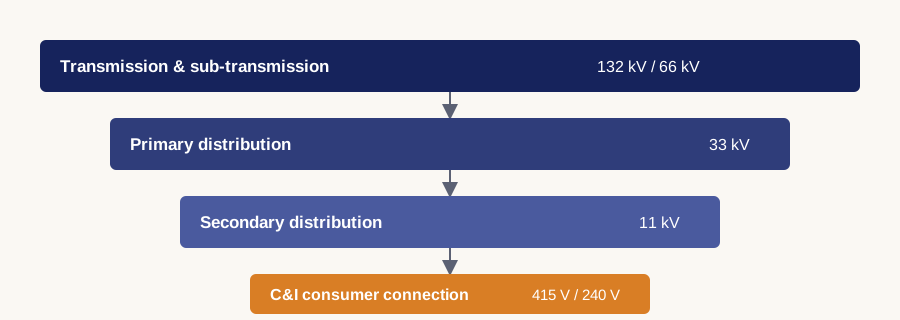
Uganda's power network is structured around a small number of voltage tiers that every C&I solar designer must locate their client within: 132 kV and 66 kV transmission and sub-transmission, 33 kV primary distribution, and 11 kV and below for secondary distribution and consumer connection. Most C&I sites of interest for solar retrofitting sit at the 11 kV or 415 V/240 V level, supplied from a dedicated transformer or a shared distribution feeder. Three characteristics of this environment shape design decisions more than textbook PV engineering assumptions typically allow for:
- Voltage variability. Feeder-end voltage drop and fluctuation are more pronounced on longer rural and peri-urban 11 kV lines than on the compact networks assumed in most manufacturer inverter defaults, which are frequently calibrated to European or Gulf grid conditions.
- Supply interruption frequency. Planned and unplanned outages remain a material operating risk for C&I loads, which is precisely why grid-tied-only PV (without storage or backup provision) leaves a client's core resilience problem unsolved even as it reduces energy cost.
- Regulatory oversight by the Electricity Regulatory Authority (ERA). Any generation asset connected in parallel with the grid, above defined thresholds, triggers licensing, metering, and protection requirements that must be designed in from the outset rather than retrofitted after commissioning.
2. Establishing the Design Basis: Load Profiling Before Panel Counting
The most common design error in C&I solar proposals is sizing from a client's monthly kWh bill rather than from an interval load profile. A factory with a flat 24-hour process load and a hotel with a sharp evening demand peak may consume identical monthly energy yet require fundamentally different PV-to-load ratios, inverter configurations, and storage strategies (if any). Before any sizing calculation, the following should be established:
- An interval (ideally 15- or 30-minute) load profile over a representative period, capturing seasonal variation where the client's operations are seasonal (agro-processing is the clearest example in the Ugandan context).
- The proportion of load that is coincident with solar generation hours (roughly 08:00-17:00), since energy exported to the grid or curtailed has materially different value depending on the connection's commercial arrangement.
- Any process loads sensitive to voltage or frequency disturbance, which affect inverter and protection settings more than they affect array sizing.
Only once the coincident-load fraction is understood should the designer size the array against average daily irradiance. Uganda's location near the equator gives it a comparatively favourable and stable solar resource, with global horizontal irradiance in most parts of the country in the broad range typically cited for East African sites, though local shading, dust accumulation in dry season, and cloud cover during the two rainy seasons all reduce effective yield below theoretical maximums and should be reflected in performance ratio assumptions rather than treated as a rounding error.
3. Grid-Tied, Hybrid, or Off-Grid: Matching Topology to Risk Tolerance
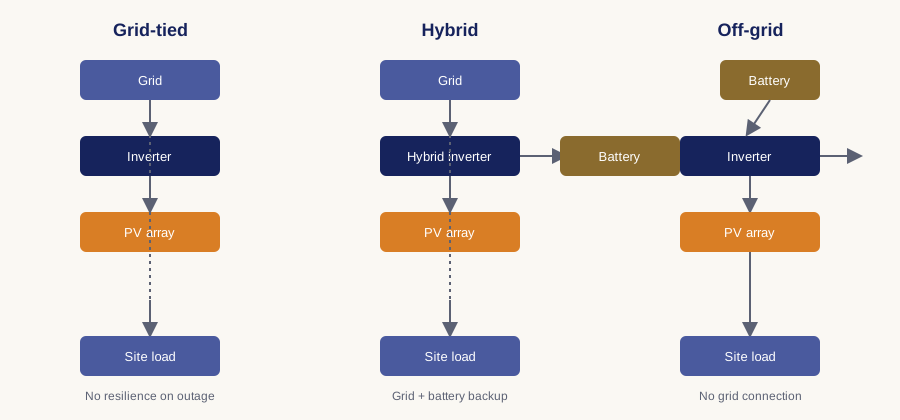
Three system topologies dominate C&I proposals, and the choice between them is a risk-management decision as much as a technical one:
3.1 Grid-tied (no storage)
Lowest capital cost per installed kWp, simplest protection scheme, but offers zero resilience during grid outages: inverters must disconnect on loss of mains (anti-islanding) for safety, meaning the client loses both grid and solar supply simultaneously during an outage. This topology suits clients whose primary objective is energy cost reduction rather than reliability.
3.2 Hybrid (grid-tied with battery storage)
Adds a battery inverter or hybrid inverter capable of forming an islanded microgrid for critical loads during outages, while still interacting with the grid under normal conditions. This is the topology increasingly specified by informed C&I clients in Uganda, since it addresses reliability and cost simultaneously, at the expense of a materially higher upfront cost driven by battery capacity.
3.3 Off-grid or islanded
Relevant primarily for sites without an economic grid connection option, or where the client wishes to entirely bypass utility dependency. Increasingly rare for C&I retrofits in areas with existing UEDCL or grid-operator supply, but remains the standard topology for remote agricultural and extraction sites.
4. Inverter Selection and Grid-Tie Compliance
Inverter selection should be treated as a compliance decision before it is treated as a cost decision. Grid-interactive inverters connected to the Ugandan network should, at minimum, provide:
- Anti-islanding protection compliant with recognised international standards (commonly IEC 62116 or equivalent), to prevent the PV system from continuing to energise a de-energised section of the grid, a safety-critical requirement for utility line workers.
- Configurable voltage and frequency ride-through settings appropriate to Uganda's grid code rather than left at factory defaults calibrated for other jurisdictions.
- Total harmonic distortion (THD) performance within the limits typically required for connection agreements, since C&I sites with non-linear loads (variable-speed drives, UPS systems) already contribute harmonic content that a poorly filtered inverter can compound.
- Remote monitoring and export limitation (zero-export or capped-export control) capability, since many Ugandan grid-operator connection agreements for embedded generation restrict or disallow export to the network, requiring the inverter to throttle output to match on-site consumption in real time.
String inverters remain the dominant choice for C&I rooftop systems below roughly 500 kWp due to lower cost and simpler fault isolation; central inverters or power stations become more competitive above this threshold, particularly for ground-mounted systems on industrial or agricultural land.
5. Power Quality and Voltage Regulation
A frequently underestimated design consideration is the effect of embedded PV generation on local voltage levels, particularly on longer or weaker 11 kV and LV feeders common outside central Kampala. High solar output at midday can, in some feeder configurations, cause a local voltage rise that pushes the point of connection outside statutory voltage bands, especially where the PV system represents a large fraction of the feeder's minimum daytime load. Mitigations available to the designer include:
- Reactive power (volt-VAR) control functions within the inverter, where the utility connection agreement permits their use.
- Appropriately sized point-of-connection transformer taps and cable sizing, rather than defaulting to minimum-cost cabling.
- Engaging the relevant distribution licensee's technical team during design, not after installation, particularly for systems above the small-scale embedded generation threshold.
6. Battery Storage Economics for Hybrid Systems
Where storage is included, sizing should be driven by a defined objective rather than an arbitrary hours-of-autonomy figure. Common C&I objectives, each implying a different sizing methodology, include:
- Outage ride-through for critical loads only (server rooms, cold storage, essential process control), typically the most capital-efficient use of storage, since it sizes battery capacity against a small subset of total site load.
- Peak shaving against demand-based tariff components, where applicable, sized against the magnitude and duration of the client's peak demand events rather than total energy.
- Full site backup, the most capital-intensive objective and one that should be interrogated closely with the client, since it is frequently specified by default rather than by genuine operational requirement.
Battery chemistry selection for the Ugandan C&I context increasingly favours lithium iron phosphate (LFP) over older lead-acid or NMC chemistries, on the basis of cycle life, thermal tolerance in high ambient temperature installations, and total cost of ownership over a typical 10-15 year system life, even where upfront cost per kWh remains somewhat higher.
7. Regulatory and Incentive Considerations
Any embedded generation project of meaningful scale should be assessed against ERA's licensing and generation permit thresholds early in the design process, since licensing requirements affect timeline and documentation obligations rather than technical design directly. Designers and developers should also be aware of the legacy of donor- and government-backed renewable energy support mechanisms in Uganda, including the GET FiT programme, which materially shaped the country's small-scale renewable generation landscape in the preceding decade and continues to inform regulatory expectations around interconnection and metering standards for embedded generators, even for projects that fall outside feed-in tariff eligibility themselves.
8. An Illustrative Economic Framework
Precise payback periods depend on site-specific tariff category, load coincidence, and system configuration, and should always be modelled individually rather than quoted generically. As a framework, however, C&I solar economics in Uganda are generally governed by three levers, in descending order of typical sensitivity:
- Coincident self-consumption fraction: the proportion of solar generation consumed on-site rather than exported, which is usually the single largest driver of project returns given typically limited or unfavourable export arrangements.
- Applicable retail tariff category: commercial and industrial tariffs against which solar generation is offset determine the value of every displaced kWh, making accurate tariff modelling essential before any headline payback figure is presented to a client.
- System availability and performance ratio: realistic assumptions, informed by actual operating data from comparable regional installations rather than manufacturer datasheet conditions, materially affect projected generation and therefore returns.
Well-designed C&I systems in the Ugandan market are generally expected to deliver simple payback within a single-digit number of years, with system life extending well beyond that payback point given the low mechanical maintenance burden of static PV arrays, though any figure quoted to a client should be derived from that client's specific load and tariff data, not from sector averages.
Conclusion
Commercial and industrial solar PV in Uganda has matured past the point where a system can be responsibly specified from a monthly energy bill and a rule-of-thumb panel count. The interaction between embedded generation and a grid environment characterised by voltage variability, interruption risk, and an evolving regulatory framework demands a design process grounded first in load profiling, then in topology selection matched to the client's actual risk tolerance, and only then in equipment specification. Firms operating in this space carry a responsibility to bring that rigour to every proposal, not only because it produces better financial outcomes for clients, but because poorly specified embedded generation has real consequences for the safety and stability of the wider distribution network on which it depends.